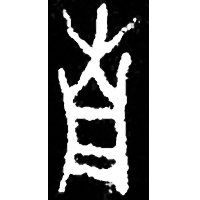
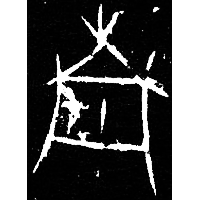
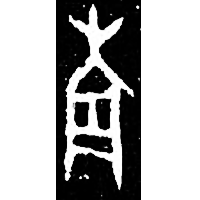
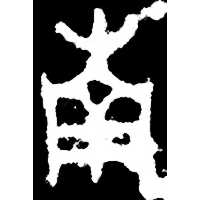
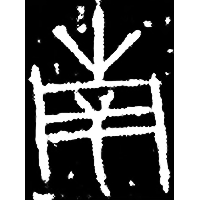
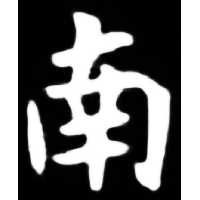
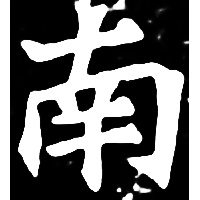
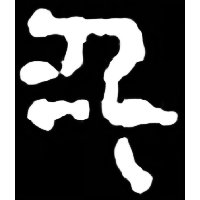
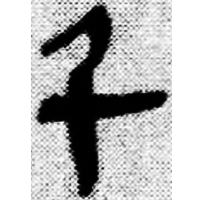
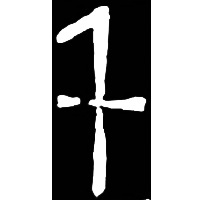
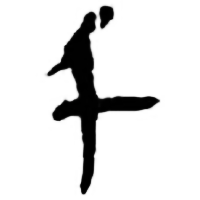
十 (U+5341)
{十} *[ɡ]ip “ten”
Unknown. Probably 一 “one” turned vertically.
- 丁山 1928 - 數名古誼
- 于省吾 1979 - 甲骨文字釋林・釋一至十之紀數字 (100)
- 季旭昇 2014 - 說文新證 [2nd ed.] (155)
{十} *[ɡ]ip “ten”
Unknown. Probably 一 “one” turned vertically.
| Shang (Shi-Bin) | Shang (Bin) | Late W.Zhou | Zhanguo (Qin) | Qin | Qin | Qin | W.Han | Nanbei (N.Wei) |
|---|---|---|---|---|---|---|---|---|
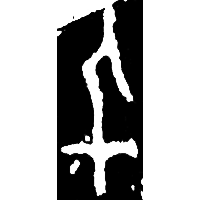 | 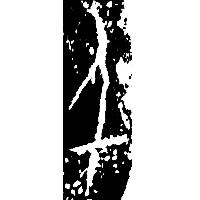 | 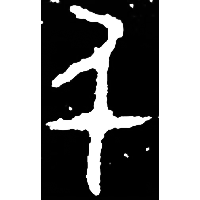 |  |  |  |  | 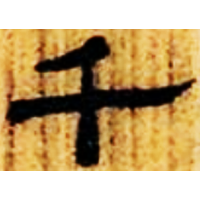 | 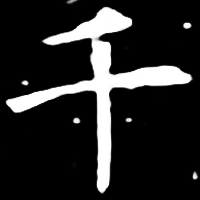 |
| 合4992 | 合14456反 | 集2768 | 青川木牘 | 睡.效9 | 陶錄6.282.4 | 嶽二.數113 | 北.老221 | 南0341X |
{一千} *ʔit (C)Vs.nˤiŋ “one thousand” → {千} *(C)Vs.nˤiŋ “thousand”
Initially the word {千} was written phonetically as 人 *NIŊ. The glyph 一 ONE was added to represent the compound {一千}, giving the ligature 千. Later this ligature began to be used for the morpheme {千} itself.