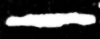
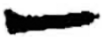
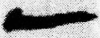
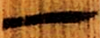
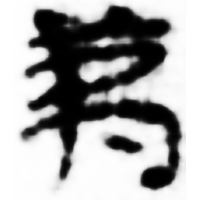
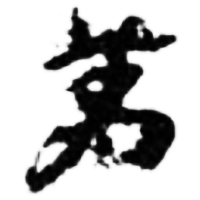
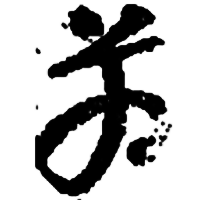
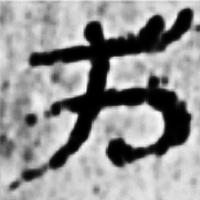
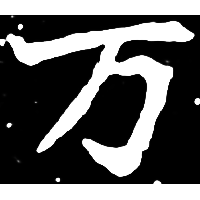
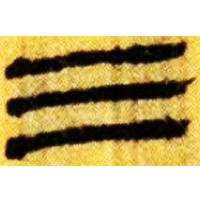
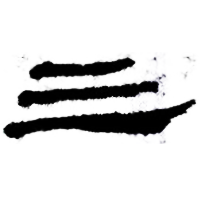
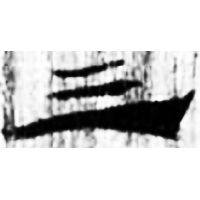
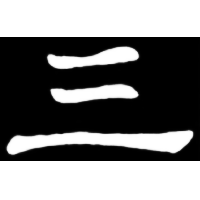
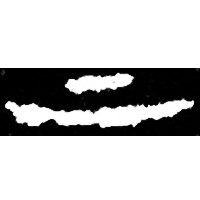
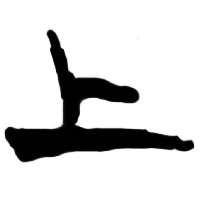
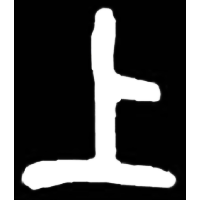
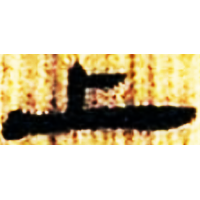
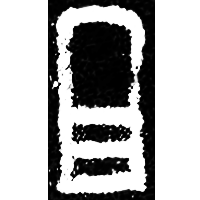
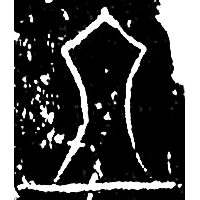
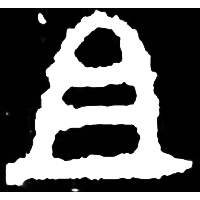
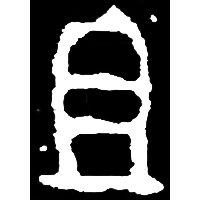
丂¹
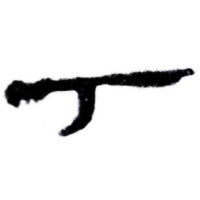
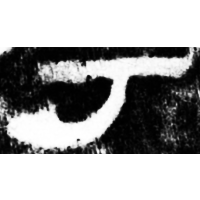
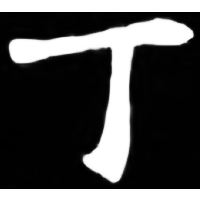
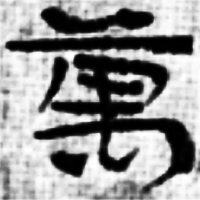
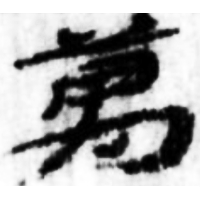
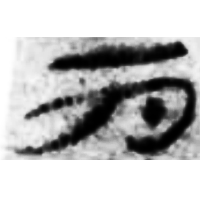
*{丂} *kʰouᴮ “the appearance of air which is to be released”
Shortened form of 考. It and its usage was created for Shuowen Jiezi
to explain its form and appearance in glyphs such as 号 “to yell” or 兮 “exclamatory particle”.
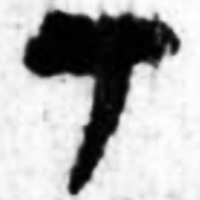
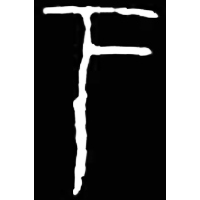
丂²
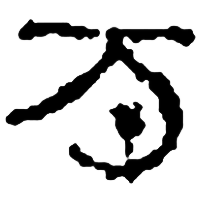
{柯} *[k]ˤar “axe-handle”
Depiction of an axe-handle.
- 屈萬里 1961 - 殷墟文字甲編考釋 (398)
- 林志強 & al. (ed.) 2017 - 《文源》評注 (119)
- 王帥 2018 - 甲骨文“丂”、“昜”新解
- 李春桃 2020 - 甲骨文中“丂”字新釋
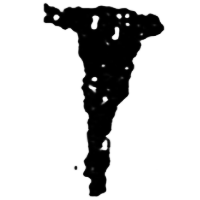
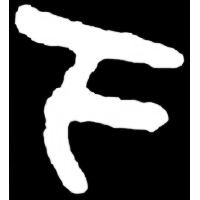
丂³
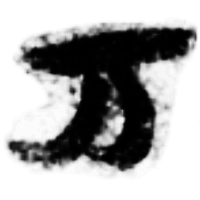
{杖} *lraŋʔ “cane”
Depiction of a cane.
- 陳劍 2018 - 以一些例子談談甲骨文字考釋可注意的問題
- 王帥 2018 - 甲骨文“丂”、“昜”新解
- 李春桃 2020 - 甲骨文中“丂”字新釋
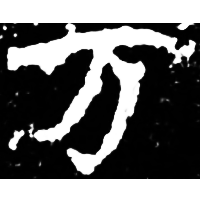
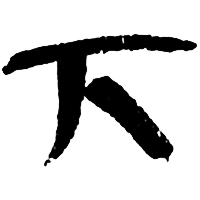
{七} *(C)Vs.ni[t] “seven”
Unknown. Likely an early arbitrary sign.
- 裘錫圭 2013 - 文字學概要 [2nd ed.] [2021 form.] (5, 31-32)
- 復旦大學出土文獻與古文字研究中心 (ed.) 2024 - 出土文獻與古文字教程・導言 (14)
Forms:
𠀁 - Copy of the small seal script form from Shuowen Jiezi.
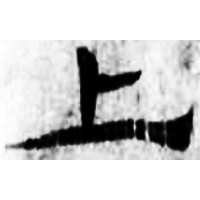
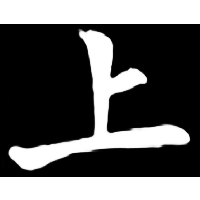
丄¹
Copy of the small seal script form of 上 from Shuowen Jiezi.
丄²
{牡} *mruʔ “male (animal)”
Abstract depiction of a penis.
- 季旭昇 2002 - 說“牡”“牝”
- 周忠兵 2006 - 甲骨文中幾個從“丄(牡)”字的考辨
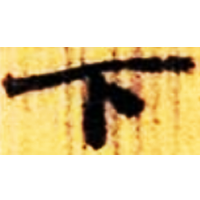
Copy of the small seal script form of 下 from Shuowen Jiezi.
?{杖} *lraŋʔ “cane”
Unknown. Probably depiction of a hand with a cane.
- 黃德寬 (ed.) 2007 - 古文字譜系疏證 (1822)
- 林志強 & al. (ed.) 2017 - 《文源》評注 (273)
Forms:
𠀋 - Addition of a decorative dot.
?{𩭺/副} *pʰəks “false hair” ♪→ {不} *pə “not”
Probably rotated depiction of hair.
- 陳世輝 1983 - 釋⿰耑戈——兼說甲骨文不字
- 徐在國 2016 - 談銅器銘文中的“不”
Forms:
𠀚 - Copy of the small seal script form from Shuowen Jiezi.
Shortened form of 與. Modern simplified form of 與 in China and Japan.
- Bökset R. 2021 - Long Story of Short Forms: Simplified Chinese Characters from A to Z (354-355)
?{丐} *kˤats “to beg”
刀 + 亡. Composition unexplained.
Forms:
丏 - Alternative form.
?{扭} *nruʔ “to grab” ♪→ {丑} *p.nruʔ “chou (2nd earthy branch)”
Depiction of a hand with bent fingers.
- 楊澤生 2022 - 論甲骨文的「收」字及相關問題
Forms:
丒 - Alternative form.
Shortening of 專 based on the cursive form. Modern simplified form of 專 in China.
- Bökset R. 2021 - Long Story of Short Forms: Simplified Chinese Characters from A to Z (383)
{丕} *pʰrə “grand”
♪不 *PƏ + decorative stroke.
- 季旭昇 2014 - 說文新證 [2nd ed.] (41-42)
{世} *C̥.laps “generation”
Shortened form of 枼.
- 裘錫圭 2013 - 文字學概要 [2nd ed.] [2021 form.] (165-166)
Forms:
𠀍 丗 - Alternative form.
{丘} *kʷʰə “hill”
Depiction of two mountain peaks.
- 季旭昇 2014 - 說文新證 [2nd ed.] (652-653)
Forms:
丠 丛 𠀌 㐀 业 𠀜 - Copy of the small seal script form from Shuowen Jiezi.
𠀈 - Alternative form.
𠀉 - Shortened (tabooed) form.
?{房} *[b]aŋ “cutting board” ♪→ {丙} *praŋʔ “bing (3rd heavenly
stem)”
Unknown. Probably depiction of a cutting board.
业¹
Shortening of 業. Modern simplified form of 業 in China.
- Bökset R. 2021 - Long Story of Short Forms: Simplified Chinese Characters from A to Z (338)
业²
Copy of the small seal script form of 丘 from Shuowen Jiezi.
业³
Alternative form of 北.
丛¹
{叢} cóng “to gather”
♪从 CONG + differentiative stroke. Created for simplifying 叢 in China.
- Bökset R. 2021 - Long Story of Short Forms: Simplified Chinese Characters from A to Z (79-80)
丛²
Copy of the small seal script form of 丘 from Shuowen Jiezi.
Shortening of 東 based on the cursive form. Modern simplified form of 東 in China.
- Bökset R. 2021 - Long Story of Short Forms: Simplified Chinese Characters from A to Z (96)
Shortening of 絲 based on the cursive form. Modern simplified form of 絲 in China.
- Bökset R. 2021 - Long Story of Short Forms: Simplified Chinese Characters from A to Z (278)
{拯} *təŋʔ “rescue; lift up” / (♪→) {丞} *m.təŋ “assist”
Depiction of pulling a kneeling man (卩) out of the hole (凵) with hands
(廾).
- 季旭昇 2014 - 說文新證 [2nd ed.] (173-174)
丠¹
Copy of the small seal script form of 丘 from Shuowen Jiezi.
丠²
Shortening of 冀 replacing 異 YI with homophonous 一 YI. Was included in the second round of simplification for 冀.
- Bökset R. 2021 - Long Story of Short Forms: Simplified Chinese Characters from A to Z (146-147)
Shortening of 兩 based on the semi-cursive form. Modern simplified form of 兩 in Japan.
- Bökset R. 2021 - Long Story of Short Forms: Simplified Chinese Characters from A to Z (194-196)
Copy of a transmitted ancient form of 卯.
Shortening of 兩 with deleting the middle vertical line. Modern simplified form of 兩 in China.
- Bökset R. 2021 - Long Story of Short Forms: Simplified Chinese Characters from A to Z (194-196)
Shortening of 嚴 based on the cursive form of the upper part with deleting the inner element. Modern simplified form of 嚴 in China.
- Bökset R. 2021 - Long Story of Short Forms: Simplified Chinese Characters from A to Z (328)
{並} *bˤaŋʔ “to stand side by side” → {併} *bˤeŋʔ “to stand side by
side; together”
Depiction of two people standing side by side. Later a synonymous word
{併} became the main one for this glyph.
- 季旭昇 2014 - 說文新證 [2nd ed.] (783-784)
- 裘錫圭 2002 - 讀書札記四則・“秉時養人”之“秉”爲“並”之音近訛字
- 布之道 2022 - 廣韻形聲考
Forms:
𠀤 - Copy of the small seal script form from Shuowen Jiezi.
Shortening of 喪 based on the semi-cursive form. Modern simplified form of 喪 in China.
- Bökset R. 2021 - Long Story of Short Forms: Simplified Chinese Characters from A to Z (261)
Copy of the small seal script form of 丘 from Shuowen Jiezi.
{簟} *lˤimʔ “bamboo mat” ♪→ *{㐁} *C̥.lˤəms “to lick”
Depiction of a mat. The later usage was created for Shuowen Jiezi to
explain its form.
- 季旭昇 2014 - 說文新證 [2nd ed.] (149)
Shortening of 喜 based on the cursive form.
- Bökset R. 2021 - Long Story of Short Forms: Simplified Chinese Characters from A to Z (308-309)
{呵} *hɑj “excoriate” ♪→ *{𠀀} *hɑj “non-blocked outgoing air”
Mirrored 丂. Created for Shuowen Jiezi to explain its appearance in
glyphs like 可 “to accept”.
𠀁¹
Copy of the small seal script form of 七 from Shuowen Jiezi.
𠀁²
ronz “to reach; to pass” (Bouyei)
Unknown.
?{𠀂} yǐ “Taiwanese name”
Unknown. Probably ♪一 YI + ♪乙 YI.
𠀃¹
Transmitted ancient form of 且. Also, shortening of 且.
𠀃²
Shortening of 皿 with deleting the middle vertical lines. Was included in the second round of simplification for 皿.
𠀃³
ningq “penis” (Zhuang)
Abstract depiction of a penis.
𠀅¹
Alternative form of 亥.
𠀅²
eg “wealthy” / geangx “smart” (Bouyei)
Unknown.
Transmitted ancient form of 且. Also, shortening of 且.
Shortened (tabooed) form of 丘.
Copy of the small seal script form of 丘 from Shuowen Jiezi.
Bottom part of 𠌺 created for describing characters in some classical dictionaries.
?{𠀏} tún “Taiwanese name”
Unknown. Probably ♪屯 TUN + decorative stroke.
Copy of a transmitted ancient form of 天. One of the Wu Zetian characters.
Copy of the small seal script form of 平 from Shuowen Jiezi.
(khệnh) khạng “in a slow walk with difficulty” (Vietnamese)
Differentiated form of ♪共 CUNG/CONG.
khệnh (khạng) “in a slow walk with difficulty” (Vietnamese)
Differentiated form of ♪共 CUNG/CONG.
Copy of a transmitted ancient form of 天.
Copy of a transmitted ancient form of 麗.
Copy of the small seal script form of 不 from Shuowen Jiezi.
Copy of a transmitted ancient form of 玉.
𠀜¹
Copy of the small seal script form of 丘 from Shuowen Jiezi.
𠀜²
Alternative form of 皿.
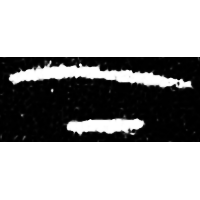
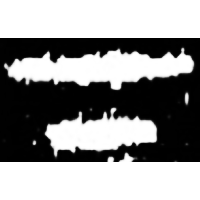
{空} kōng “sky”
下 BELOW (below the heavens) + 上 ABOVE (above the earth).
Copy of a transmitted ancient form of 麗.
{箕} *krə “winnowing basket”
Depiction of a winnowing basket.
- 季旭昇 2014 - 說文新證 [2nd ed.] (376)
Copy of a transmitted ancient form of 天.
Copy of the small seal script form of 並 from Shuowen Jiezi.
cụp “to hang down” (Vietnamese)
下 DOWN + ♪及 CAP.
Copy of the small seal script form of 𢆊 from Shuowen Jiezi.
(khề) khà “to have a drunken brawl” (Vietnamese)
Differentiated form of 其 KI.
khề (khà) “to have a drunken brawl” (Vietnamese)
Differentiated form of 其 KI.
Note 7̣̣ in the Kunshan opera gongche notation.
一 (note 7̣) with a hook.
eda-nasi “without branches” (Japanese)
木 TREE without bottom diagonal strokes.
{𰀀(子)} zuì(zi) “yoke nail” (Lower Yangtze Mandarin)
Mirrored 丁 (with the usage for {釘} “nail”).